|
Home
About Music & Medicine
Publications & Research
Current Research Projects
Services
Children
Adults
Education & Training
Events & Symposia
IAMM
In the News
Speaking Engagements
Our Staff
Make a Donation
Contact US
Site Map
|
|
|
The fetus is part of a system, dependant upon the physiological condition
and emotional states of another human being. From both medical and music
therapy perspectives, working within the meter of respiratory and cardiac
rates of both mother and fetus within the context of entrainment may have
important synchronous medical implications. The life rhythm of the heart
is the first sound that a developing fetus hears in the womb. The significance
of a steady pulse has been noted as a primary means of awareness, as in
the concept of basic beat (Nordoff-Robbins, 1975), and has been an indicant
of neurological functioning in older adults (Tomaino, 1999; Clair et al,
1995). Complementary medicine programs have incorporated aspects of rhythm
and breath work into specific methods that have enhanced relaxation in
pregnant women. Breath attunement has been effectively influenced through
music therapy. Since the body actively uses respiratory mechanisms to
play wind instruments and to sing or tone, the use of these applications
can be efficiently monitored and physiologically served through music
therapy when the fetus is in the womb, as well as when the infant is outside
the mother's body. Purposeful sustenance of the musical aspects of this
environment can provide continuity, thus sustaining the rhythmic, flowing
components.
NICU Music Therapy: The Role of Attachment
Bonding and the role that the emotional status or the mother
and father play in the development of bonding may be at risk when the
infant is hospitalized. Music can normalize the relationship and enhance
feelings of closeness during an otherwise seemingly confined period.
Although the music therapy NICU literature has recognized the value of
mother's voice, neonatal clinicians and music therapists have not investigated
the impact of mother's emotional status upon the neonate. This would include
an assessment of how music therapy treatment might be most effectively
pursued for both parent/caregiver and baby. An avoidance of this evaluation
could pose significant threats to the fragile baby and growing relationship.
If mother has not recognized and addressed her own feelings of anxiety
associated with having an infant prematurely, an infant who may be dangerously
ill, her provision of music could be contraindicated. Themes of anxiety
and separation tend to usurp the premature baby's parents' bonding abilities
(Harris, G., 1994).
Two European music therapists introduce this important topic in an introductory
way. Nocker-Ribaupierre (2004, 1998) studied the short- and long-term
effects of the maternal voice on the behaviors of very-low-birth-weight
infants in conjunction with their mothers and how this affected the bonding
process. Lenz (1998) looked at interactional disorders in terms of aspects
of bonding between mothers and infants. The Beth Israel referral
form provides a mechanism for psychosocial needs. Therapists will
be alerted to specific psychotherapeutic needs which are identified by
staff in the comment section. Loss of a twin, previous birth trauma, drug
use, domestic violence and first time parent/s are common referral criteria
identified in this domain.
There are several studies that recognize the importance of mother's voice
and the infant's ability to recognize both mother's and father's voice
(Coleman, et al, 1998, Rock et al, 1999). The literature is missing clinical
work with mothers and fathers from a music psychotherapy perspective,
which preempts working with the parent-child dyad. Clearly, the field
of music therapy will benefit from more case studies and illuminated methods
of how music therapy can impact the bonding process. When applicable in
this study, we will include in the assessment how music therapy may address
the parent/caretaker's anxiety, and how it may affect the implementation
of parenting/bonding. The referral/assessment, which includes a parental/family
assessment and consultation with the social worker and nurses who provide
data on parental intervention of music, will be imperative in the intervention.
Such data collection is a primary modality of treatment prior to the
music therapist working with the infant, and/or the infant and parent
together. The music provided for the infant is most beneficial when we
can address the music maker and how effective he/she is in creating an
environment of homeostasis for the dyad.
Music Therapy: A Risk-Free Intervention
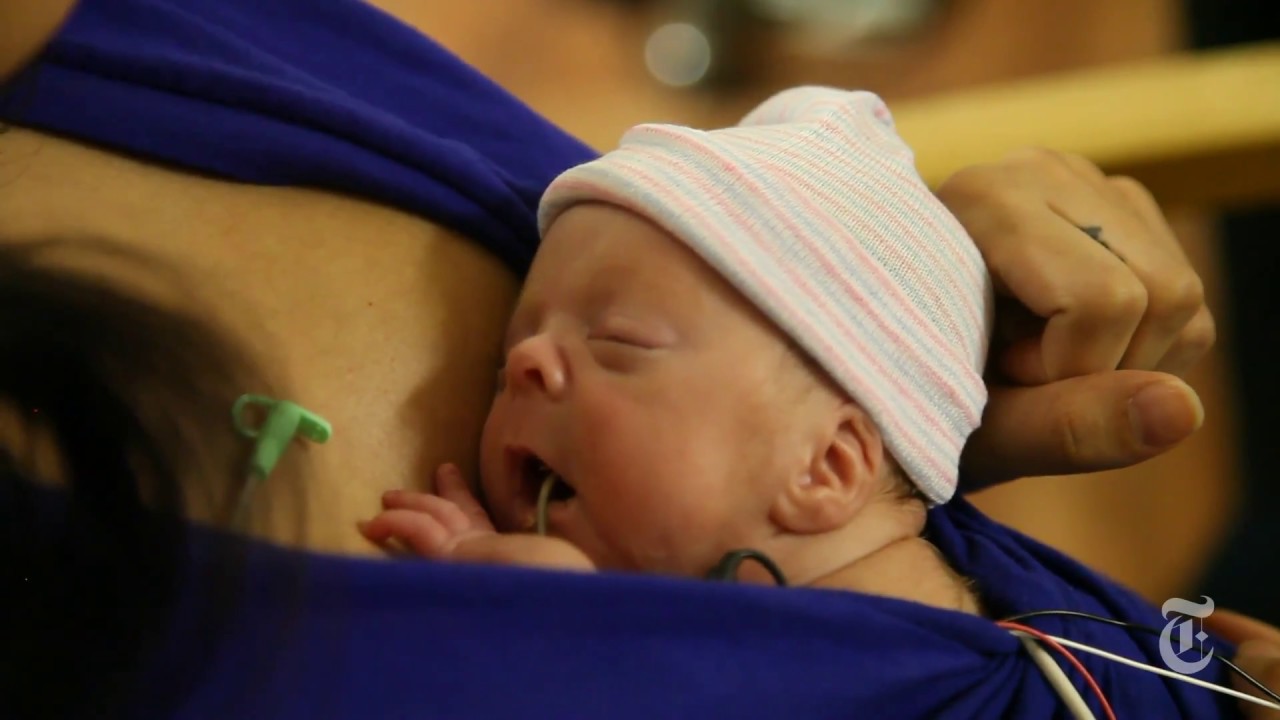
The use of music therapy in the treatment of infants that are
premature is a safe modality. Since music is an acoustic modality, the
infant can be held and then gradually moved to the isolette or bassinette,
while the therapist provides a continuous momentum and feeling of motion,
through musical phrasing. This can induce a sense of homeostasis for the
infant in virtually a very short period of time. Such an effect is achieved
through principles of entrainment (Loewy, et al, 2005, Bradt & Dileo,
1999, Rider, 1997). The premise that premature infants seek rhythmic stimulation
is not new to the medical literature. Thoman, et al, 1991, studied the
effects and the experience of entrainment and how it facilitated neurobehavioral
development. The study was reviewed in the Journal of Developmental Behavioral
Pediatrics. Entrainment was achieved through the use of a breathing bear
device that reflected the infants' breathing patterns. Eventually, the
infants with this devise in their bassinettes demonstrated more regulated
breathing patterns and improved oxygenation.
More pages on NICU Music Therapy at Beth Israel:
References
Attia, J., Amiel-Tison, C.,Mayer, N., Shnider, S., &Barrier,
G. (1987). Measurement of postoperative pain and narcotic administration
in infants using a new clinical scoring system. Anesthesiology
67: A532.
Bradt, J. & Dileo, C. (1999). Entrainment, Resonance, and Pain-Related
Suffering. In C Dileo (ed) Music Therapy & Medicine: Theoretical
and Clinical Approaches, pp.181-206. Silver Spring, MD: The American
Music Therapy Association.
Clements, A. (1996). New sense out of old sense. In R. Pratt & Groke,
D. (eds.) Musicmedicine 3: Expanding Horizons , pp101-119. Melbourne,
Australia: University of Melbourne.
Courtnage, A., Chawla, H., Loewy, J. & Nolan, P. (2002). Effects of
live infant directed singing on oxygen saturation, heart rate, and respiratory
rate of infants in the neonatal intensive care unit. Pediatric Research
51, (4).
Liebman, S. (1989). The effects of music and relaxation on third trimester
anxirty in 3rd trimester anxiety in adolescent pregnancy. Unpublished
doctoral thesis. Miami.
Linquist, R. (1985). The role of GIM in the birthing process.
Unpublished fellows paper. Institute for music and consciousness. Townsend,
WA.
Loewy, J. Hallan, C., Friedman, E. & Martinez, C. (2005). Sleep/Sedation
in Children Undergoing EEG Testing: A Comparison of Chloral Hydrate
and Music Therapy. Journal of Perianesthesia Nursing, 20 (5),
323-31.
Loewy, J.V. (2004). A Clinical Model of Music Therapy in the NICU. In
M. Nocker-Ribaupierre (ed.), Music Therapy for Premature and Newborn
Infants (Susan Weber, Trans.). Gilsum, N.H.: Barcelona Publishers.
Loewy, J.V. (2003). Aufbau eines Musiktherapieprogramms fur neugeborene
Kinder - Einfuhrung und Quellen-NICU Music therapy. In M. Nocker-Ribaupierre
(Hg.), Horen - Brucke ins Leben, Musiktherapies mit fruh - und neugeborenen
Kindern, Forschung und klinische Praxis. Gottingen, Germany: Vandenhoeck
& Reprecht.
Loewy, J. V. (2000) Music Therapy in the NICU. NY, NY: Satchnote
Armstrong Press.
McKinney, C. (1990). Music therapy in obstetrics: A review. Music
Therapy Perspectives . 8: 57-60.
Nordoff, P, Robbins, C. (1975) Creative Music Therapy. New York:
Samuel Day.
Ribaupierre, M.N. (2004). Music Therapy for Premature and Newborn
Infants. Gilsum, N.H.: Barcelona Books.
Pratt, RR. (1999). Music and infant well-being. In R.R. Pratt & D
Grocke, (Eds), MusicMedicine 3-Expanding horizons. Melbourne,
Australia: University of Melbourne.
Stewart, K. & Schneider, S. (2000) Environmental Music Therapy. In
Loewy J. V. (Ed) Music therapy in the NICU. NY, NY : Satchnote
Armstrong Press.
Thoman, E.B., Ingersoll, E.W. & Acebo, C. (1990) Premature infants
seek rhythmic stimulation and the experience facilitates neurobehavioral
development. J. of Developmental and Behavioral Pediatrics, 12(1),
11-18.
Tomaino, C. (1998). Music On their minds: A qualitative study of the
effects of using familiar music to stimulate preserved memory function
in persons with dementia. Doctoral Thesis: New York University.
Winslow, G. (1986). Music therapy in the treatment of anxiety in hospitalized
high-risk mothers. Music Therapy Perspectives, 3:29-33.
|